
Wealth starts with savings
-how to start investing
For most of us, wealth is built through savings that accumulate over time. Although a relatively small number of people receive unexpected capital (a gift, an inheritance, marrying someone wealthy, or even winning the lottery), most people have to put money aside. Whether you invest a lump sum or you contribute small amounts regularly, every dollar saved brings you closer to your goals. Daily expenses can quickly add up, making it harder to save. Fortunately, it's possible to stay on track with your savings, and over time, every small amount can make a difference.
Systematic Savings
You can save a large amount of money at once but the cost of living and everyday expenses often eat into the amount you hoped to save. Systematic savings then becomes an appealing option:
The earlier you start, the faster your savings grow
Saving small amounts is easier
Scheduling automatic withdrawals allows your savings to build up on their own
Amounts and frequency can be adjusted for greater flexibility
Investing small amounts regularly can protect you from market volatility.
As shown in the table below, any amount saved on a recurring basis can make a difference.
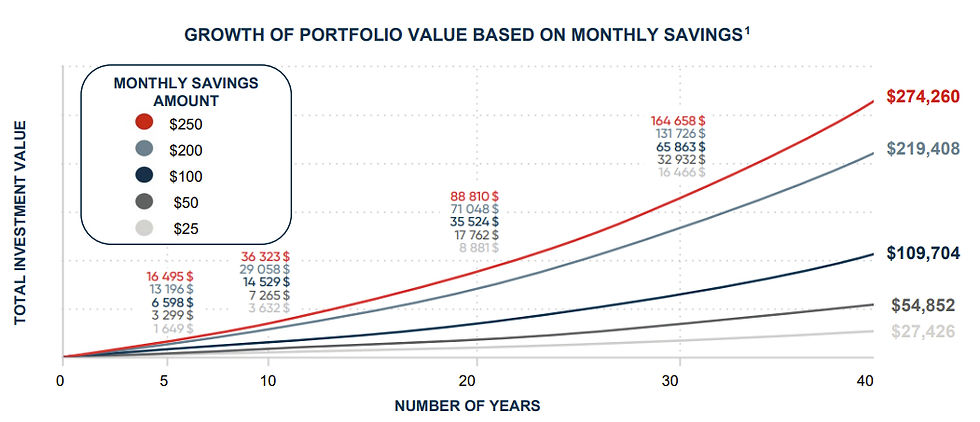
1 Table from the 2025 Investing Guide – National Bank Financial Wealth Management, p.22. Calculation based on an actual 3.75% return
Regardless of your goals (an emergency fund, buying a home, a comfortable retirement, etc.), the key is to adopt a savings approach based on the following three principles:
Pay yourself first
We can set up an automatic savings plan that deducts money from your paycheque or bank account before you have a chance to spend it. To make the transition easier, start with 10% of your net pay – what you receive after tax and other deductions.
Then move to 10% of your gross pay within a year or two. Remember to increase the dollar amount of this 10% commitment as your income goes up. In addition, if you occasionally receive money at work such as an annual bonus, saving at least 80% of the after-tax value can help you grow your savings.
Look for ways to reduce spending without sacrifice
Statistics Canada says the average family spends nearly $26,875 a year on food, clothing, and transportation. Can you trim that by 10% or approximately $2,700 by watching for sales, making different choices, and cutting back on unnecessary driving? If your salary is $90,000, a $2,700 reduction in spending is the same as getting a 3% bonus from your employer. Prudent shopping for major items such as cars and appliances can really free up a significant amount of money. Taking the time to think before making a purchase, regardless of the amount, can help you control impulse spending. Ask yourself whether you really need it, whether you could save buying used or choosing a less high-end model.
Avoid getting into debt to fund your lifestyle
Credit is easy to access but can become a problem. Paying with a credit card has never been easier, especially when you think that people can pay with their phone or even their smartwatch. Marketing research has found that shoppers are typically less selective and more likely to spend when paying with a credit card. Similarly, leasing, lines of credit and other borrowing arrangements, such as instalment payments, make it easy to live beyond our means.
This can be problematic in five ways:
Interest rates are often significant, and every dollar spent on interest is a dollar that can’t be used towards building wealth.
Borrowing costs mean the item or service you purchased can wind up costing much more than you thought.
Lifestyle purchases, such as clothing, quickly lose their value.
The need to support a lavish lifestyle limits your freedom and flexibility in terms of employment and choice of employer.
An overly lavish lifestyle will be difficult, if not impossible, to maintain in retirement – especially when that high level of spending prevents you from dedicating part of your current cash flow to wealth creation.
However, not everything is black and white. There are exceptions to these recommendations. Credit cards often come with benefits that you can take advantage of. Think of the benefits often offered – reward points or rebates – which can be very appealing. The key is to pay your balance in full every month. Overall, your total debts should not exceed 75% of your total assets unless you’re right out of school and just starting your career.
Tax refunds
Many taxpayers look forward to the spring hoping to get a refund when they file their tax return. It could be tempting to splurge a little when you receive your refund. Consider spending only 10% and use the rest to invest or pay down your debt. You would still get the enjoyment of a windfall, but most of the money would go to toward meeting your long-term goals. Speaking of savings, take the time to check whether your contributions to registered plans such as a TFSA, FHSA, and/or RRSP are maximized. Depending on your situation, taking advantage of those savings vehicles could reduce your taxable income, opening the door to potential savings that could result in additional savings.
If you have any questions feel free to reach out to our team members, and we are always ready to start working on your financial plan.
Comments